December 2008

'Tis the Season!


'Tis the season to be jolly and frenzied! Just like everyone else reading this blog, December is usually a very busy month preparing for the holidays. And despite all our planning, and what seemed like timely preparations, here we are, just 4 short weeks before Christmas, and only 3 weeks before the family begins to gather at our home, and many projects are well from finished! So, December is going to look a little different around here. We need to finish some major Christmas projects, so most of our crafting time will be spent finishing up gifts, not crafting new projects for the blog. If we turn out something new and doable, we will be sure to post it. But there is a good chance that we will put blinders on and stick to finishing up gifts for family and friends.

So, we'll share what we can. I haven't finished the hobby horses so the directions aren't quite ready, but still hoping to get them posted. Also, I know some of you would like to have a go at the holiday gnomes, so I'll try to make that pattern available. In the meantime, you'll probably find us sharing some of our holiday decorating ideas, wrapping projects, (check out It's A Wrap! on One Generation) and gifts from the kitchen.

We also plan to share in a different way, too. Michelle and I have about 2 dozen different types of cookies we make for the holidays. And because of the shear quantity, we start early. Some cookies, the kind that store well, we will begin to make December 1. Others that have dough that freeze well, will make, freeze the dough, and wait until closer to Christmas to bake. And the fragile cookies will be made at the last minute. As we make our cookies, we will be taking pics and sharing them along with the recipes. (We wish we could share the cookies and a nice cup of friendship tea with everyone, but since we can't, this is our way of sharing the season with you.)

We would absolutely love it if you shared pics and recipes of some of your family's favorite cookie recipes. If you'd like to, just include your recipe here, and post a pic at the flickr Wee Folk Art Crafting Club pool. If you do include a pic on flickr, please make sure to include your Wee Folk Art username so we know who you are!

So, here's hoping we all get all our projects done on time!

To start us out...here's that cup of tea we'd like to share with you. The recipe is quick and easy, lovely to give as a gift from the kitchen, or perfect for a quick calm during the hectic holidays. Enjoy and think of us!

FRIENDSHIP TEA

1/2 c. Instant Tea
3/4 c. Tang
1 c. Sugar
1/2 t. ground cloves
1 t. cinnamon

DIRECTIONS
Mix everything together and store in a air tight container.
To serve add 1 heaping tablespoon to 8 oz. of boiling water.
Sit back and enjoy!

Christmas Cookies - Shortbread

I love shortbread with my afternoon coffee. This is our first Christmas cookie for the season (it freezes well). I have never actually made it before. This is a recipe my SIL always makes and I have to say... her's is better ;) . But since they moved out of state, I will have to make due with mine until they arrive for their Christmas visit.

Scottish Shortbread

INGREDIENTS:
1/2 lb Softened Butter
1/2 C Sugar
2 C Flour
1 tsp Cornstarch

DIRECTIONS:
Mix ingredients together with hands. When the dough is thoroughly mixed and sticks together in a clump or ball, pat the dough into an ungreased pie pan. Once flat, fork and place in a cold oven. Turn the oven to 275 degrees and bake for approximately 1 hour. The shortbread is done when the outter edge is lightly brown. Tastes better if undercooked slightly.

Wool Felted Mitered Bowls

Here is a fun twist on a traditional gift basket... use a homemade felted wool bowl. My mom came up with this mitered square design bowl this past summer and we have since both made several. I love how the squares come together. It is also cool how this 'square' design ends up in a perfect bowl shape once stretched over a round tin or bowl. Gotta love felting!

We will have the knitting pattern and directions available shortly in our Crafting Club patterns. Although we have both made several of these bowls, we still consider this pattern to be in beta testing. We would love some of our registered users to give it a try and provide us with feedback and any questions before we finalize the pattern. It takes me about 2 dedicated evenings of knitting to whip one up. It uses a simple garter stitch but there are decreases and you have to pick up stitches so I would say that it is above a beginner level but really not hard at all once you get the hang of it.

What to put in it? I dressed up some of jams we made all summer long with a bit of gigham check fabric. I just cut out a circle of fabric with pinking shears. I unscrewed the jar rim without breaking the seal on the lid, centered the fabric on top and then replaced the rim.

Wool Felted Mitered Bowls - Directions


The mitered bowl is knitted in a square shape, but after felting and blocking, it will be round. Each bowl will be unique since color changing is random. Embellish with recycled buttons to make a truly one-of-a-kind bowl!


Caution: This pattern is in Beta Testing. Although we think the instructions are accurate, we may have missed something. Please notify us immediately if you encounter a problem or mistake and we will rectify the problem as soon as possible. Also, this is not a "how to knit" project. We do not explain techniques. Thanks!

Knitting Skill:

Intermediate


Materials:

5 skeins Patons Classic Wool (100 % wool; 223 yards per 3 ½ ounce skein – 204 meters per 100 gram skein) Use 5 different colors

1 US size 10 knitting needles

1 yarn needle


Gauge:

Gauge is not important in this project. Final size of project will depend on knitting tension and felting shrinkage.


Size:

Sizes are approximate and will vary depending on the yarn used and shrinkage when felted. In our example:

12 x 12 x 12 inches prior to felting

6 x 7 x 7 inches after felting


Abbreviations

WS – wrong side

sl1p – slip one stitch as if to purl

k2to – knit 2 stitches together

sts – stitches

p2tog – purl 2 together

 
Diagram

Directions: This bowl is worked in one piece beginning with the bottom. Refer to the diagram for the order of squares to knit. The squares are worked in garter stitch using 2 strands of yarn. All even rows are knit. A double decrease is worked in the center of all odd rows creating the mitered square. Change yarn colors randomly to create 5 unique blocks. Keep all lose threads on the WS.

(Hint: Knit with 2 strands of the same color or use 2 different colors. Mix it up!)


Square One - Bowl Base:

Cast on 48 sts.

Row 1: sl1p, k21, k2tog, place marker, k2tog, k22.

Row 2 and all even rows: sl1p, k remaining stitches

Row 3 and all odd rows: sl1p, k to 2 sts before marker, K2tog, slip marker, K2 tog, knit to end of row.

Continue rows 2 and 3 until 4 sts remain.

Important: The odd rows will form the inside of the bowl. Place all yarn tails on the inside.

When 4 sts remain on odd row: p2tog, k2tog.

When 2 sts remain on even row: sl1p, k1.

When 2 sts remain on odd row: Remove marker and k2tog. Do not bind off last stitch. (This becomes the live stitch.)


Square Two - Side:

From the live stitch, pick up 23 more stitches along side 2D of Square One. (Pick up 1 stitch from each garter ridge.) There are now 24 stitches on your needle. Place marker. Cast on 24 additional stitches using “cable cast on”. (Casting on additional stitches is only done on Square Two.)

There are now 48 stitches on your needle.

Next row: sl1p, k remaining stitches. (This extra row is only done on Square Two.)

Now work these 48 stitches as you did for Square One. Do not bind off last stitch.


Square Three - Side:

From the live stitch, pick up 23 more stitches along side “C” of Square Two. (Refer to diagram.) There are now 24 stitches on your needle. Place marker. Pick up 24 stitches along side 3D of Square One. There are now 48 stitches on your needle. Work these 48 stitches as you did for Square One. Do not bind off last stitch.


Square Four - Side:

From the live stitch, pick up 23 more stitches along side “C” of Square Three. (Refer to diagram.) There are now 24 stitches on your needle. Place marker. Pick up 24 stitches along side 4D of Square One. There are now 48 stitches on your needle. Work these 48 stitches as you did for Square One. Do not bind off last stitch.


Square Five - Side:

From the live stitch, pick up 23 more stitches along side “C” of Square Four. (Refer to diagram.) There are now 24 stitches on your needle. Place marker. Pick up 24 stitches along side 5D of Square One. There are now 48 stitches on your needle. Work these 48 stitches as you did for Square One. Bind off last stitch leaving long tail for sewing side seam.


Finishing:

Using the yarn tail from Square Five, sew side “C” of Square Five to side “A” of Square Two.

Secure and weave in all lose ends.

Turn bowl right side out. Fold rim over 1 inch to right side of bowl. Whip stitch rim to outer bowl. (This creates a more rigid rim after felting.)


Felting:

Felt bowl using the instructions found on the yarn or your favorite method.

My favorite method for non specific sized items (i.e. purses and bowls as opposed to shoes and clothing.) is: place in washing machine using on the hottest setting possible. (I have a front loading with a sanitizing setting. VERY hot!) Add laundry detergent to aid in felting but NO fabric softener. Through in items to aid in agitation. (I removed the Velcro and snaggy edges of a pair of my grandsons 2T snow boots that he outgrew. Works great! Some people use towels or old jeans. Anything that will beat the felting without snagging it.)


Blocking: Place bowl over a cylinder shaped plastic or tin form. You want a tight fit. Stretch bowl so sides are the same around the bowl. Allow to air dry. This may take a couple of days to fully dry. If using a metal tin, line it with plastic wrap to prevent rusting.


Note about patterns: We are sharing patterns we have designed and made for our own children, families and friends. Every effort is made to share information in a clear and accurate manner. We offer preemptive apologies for any mistakes that may be made. Please let us know via comments or emails if you stumble upon a mistake or if you encounter directions that leave your scratching your head! We will rectify the situation as soon as humanly possible!
 
Copyright © Wee Folk Art 2008 - 2009. All rights reserved. All photos, text and patterns are copyright protected. You may not copy, reproduce or redistribute any material found on WeeFolkArt.com without written permission. KM Projects retains all rights. All projects, patterns and directions are meant for your personal use and neither the patterns nor completed projects may be used for personal gain.

Spoon Doll Pattern


Think of our directions for spoon dolls merely as a starting point. Add aprons and bonnets. Partially sew up the bottom of the dress to make legs or add legs under the dress. Hair can be made from roving, yarn or painted on. If young children are making dolls, you can wrap and glue instead of sewing. The possibilities are endless. To store or display dolls, I place them is empty long necked glass beverage bottles. For young children plastic soda bottles will work, although they tip easier.


Important note about spoon dolls. Directions for spoon dolls is an “ish” thing. The length of the handle, the size and shape of the bowl will all affect the patterns used. The spoons used for in these directions are 12” long, with a long and narrow bowl approximately 1 1/2" x 3”. Lengthen or shorten patterns to fit your doll, although they do not need to be “perfect” to be lovely!   


Materials:

1/3 yard fabric for dress or robe

4” x 6” piece of wool felt for arms

1 8” pipe cleaner

5” x 5” piece of wool felt for hat (for wizard, princess, etc.)

Lace, trims, wool and fabric scraps for embellishments

roving or yarn for hair

wooden spoon – a 12” spoon was used

acrylic paints for face

crafting glue

pattern


Directions:


Face:

[1] Using acrylics, paint your doll’s face on the convex side of the bowl. I highly suggest practicing on a piece of paper before actually painting the face. Placement depends on the size of the bowl of the spoon. Remember, you will be adding a hat and/or hair, so take that into account when deciding on placement. Faces can be as elaborate or simple as you wish. You may even choose not to paint on features. It’s a good idea to sketch the features onto the spoon with a pencil that can be erased until you are satisfied. Allow to dry completely.

[2] Make copies of the pattern and cut out necessary pieces.

Queen: 2 dress/robe pieces and 2 sleeves cut from fabric; 4 arm pieces cut from felt; 2 pieces of pipe cleaners.
Maid: 2 dress/robe pieces and 2 sleeves cut from fabric; 4 arm pieces cut from felt; 2 pieces of pipe cleans, 1 5" diameter circle cut from felt, wide eyelet ribbon for apron for dress front.

Wizard: 2 dress/robe pieces and 2 sleeves cut from fabric; 4 arm pieces cut from felt; 2 pieces of pipe cleaners; 1 hat piece cut from felt.

All characters: ribbons, lace, buttons, etc. to embellish dolls.
 

Arms:

[3] To make arms place 2 arm pieces together and blanket stitch using 2 strands of embroidery floss the color of the felt. When you have blanket stitched down one side and around the hand portion, position 1 pipe cleaner so it goes down into the hand. Continue blanket stitching up the other side encasing the pipe cleaner in the arm. The pipe cleaner should be about 1/2" from the upper edge. Make the second arm in the same manner.


Sleeves:

[4] To make the sleeves turn the hem under 1/4” and press. Turn under another 1/4" and pin in place. Hand or machine stitch in place.


[5] Add lace or trim if desired.


[6] With right sides together, sew up sleeve’s side seam using a 1/4" seam allowance.


[7] Turn right side out. Position 1 arm in the sleeve so the arm is in the middle of the sleeve and the edge of the arm is even with the edge of the sleeve. Baste in place close to edge. Make the second sleeve.


Dress/Robe:

[8] To make the dress/robe make front and back separately in the same manner. Turn hem under 1/4" and press. Turn under another 1/4" and pin in place. Hand or machine stitch in place.


[9] Add lace or trim if desired.


[10] Turn neckline at fold. Turn under on second fold and stitch in place.


[11] Place sleeves on the right side of dress front as indicated on pattern and pin in place. Sew the front and back of the dress together by placing right sides together, and sewing the 2 side seams using a 1/4" seam allowance. The sleeves will be pinned in place between the front and back of the dress. (For maid's apron or any other embellishments, add them to the front of the doll before you sew front to back.)


[12] Using 6 strands of embroidery floss that match the dress color, run a gathering stitch around the neckline of the dress, about 1/4" from the edge. This will be used to gather up the dress at the neckline and secure it to the spoon.


[13] Gather the neckline enough so the dress takes form but loose enough so it will slide easily. Decide where it should be secured to the spoon. The best place is at the neck of the spoon, where the bowl is attached to the handle.


[14] When you are satisfied with the placement, lightly mark it with a pencil, slide the dress down the handle and apply a generous amount of crafting glue around the spoon at your mark.


[15] Move the dress in place and pull tautly on the gathering stitch. Tie off securely so neckline does not slip. Allow to dry completely.


Hair:

[16] Add hair using roving, yarn or paint. To make the queen’s hair I used a 12” piece of alpaca roving. I placed glue on the back, edges and front hairline then laid it in the middle of the roving. Tuck the hair until you are satisfied with the look. Add more glue around the face until you get the desired look. For the wizard, I added a beard and braided mustache. Give your doll its own unique look!


Queen's Crown:

[17] Using the desired trim, fit to the queen’s head, then stitch the trim in a circle. Position it on the queen’s head and add small amounts of glue to the back and sides to hold in place.


Wizard's Hat:

[18] If desired, stitch lace or trim to the bottom edge of the hat. Overlap the side seams and blanket stitch in place. Position on the wizard’s head and glue in place. 


Maid's Cap:
[19] Cut a 5" diameter circle out of felt. Mark a 3" diameter circle in the middle.

[20] Using 6 strands of embroidery floss, sew a gathering stitch along the 3" diameter circle.

[21] Pull gathers tight enough to fit nicely on doll's head. Apply glue to stitching line and position on doll's head. Let dry completely.

Note about hair: Use trial and error to get hair to the the look you want. Mustaches and breads, buns and braids are all possible styles. Have fun creating your doll's unique look! 

Note about patterns: We are sharing patterns we have designed and made for our own children, families and friends. Every effort is made to share information in a clear and accurate manner. We offer preemptive apologies for any mistakes that may be made. Please let us know via comments or emails if you stumble upon a mistake or if you encounter directions that leave your scratching your head! We will rectify the situation as soon as humanly possible!
 
Copyright@Wee Folk Art 2008. All rights reserved.
in

Mitered Bowl Directions


When Michelle posted her blog on the Mitered Bowls, she called me up and asked if I was up for getting the directions together. Okay, I put the afghan aside, and dug through my files to find the directions I'd written up this past summer. A quick read through convinced me that a diagram was in order, so I knitted the teeny tiniest little bowl so I could properly label the diagram. Next time I machine felt, the gnomes are going to get their own mitered bowl!

Anyway...the directions are good to go and are being offered as a Crafting Club Pattern. BUT, as Michelle said, this pattern is what we would consider a Beta pattern. It is complicated enough that we would like a couple more people to knit it before we would consider the pattern "public ready". We've both knitted bowls off this pattern, but just like it's never wise to edit your own writing...it isn't a good idea to knit your own patterns. We subconsciously make corrections!

So, if you do tackle this project, (and they are certainly worth it, because they are relatively quick to make, a couple of evenings for the seasoned knitter, a wee bit longer for the adventurous beginning knitter, and it would make a wonderful gift) let us know if you encounter any problems. Fingers crossed...it will be smooth sailing! Enjoy!  

Treasure Pouch

To get more information and photos of this project, CLICK HERE and HERE and HERE and HERE.

I created the
Treasure Pouch so my grandbabies could take them along on walk-abouts. It's just big enough, 7" x 6", to tuck away several "keepers", without being too heavy or cumbersome!

Materials:
Pattern Pieces
Snail Applique Pattern
Flower Applique Pattern
1/4 - 1/3 yard woven fabric for lining (great project for fabric scraps)
2 9" x 11" piece of wool felt
wool felt scraps for applique
12 strands of 4 ply wool yarn for shoulder strap, approximately 50" long each
embroidery floss and needle
matching thread for sewing machine

Directions:

1) Download and piece the pattern together.

2) Cut out 1 front and 1 back out of felt and 1 front and back out of woven fabric.

3) Chose an applique pattern. Two appliques, a snail and a flower, are available to download or create your own design. Cut applique out of scraps of wool felt. When placing the applique on your flap, make sure it is at least 1" away from all sides and fold line.

4) With right sides together pin back lining to back felt. Sew together using a 1/2" seam allowance. Leave a 2 1/2" opening on side to turn.  

5) Trim curves to 1/4".  

6) Turn and press. Blind stitch opening closed.

7) Repeat steps 4 - 7 for front lining and front felt.


8) Place front on top of back so the front's felt side is touching the back's lining fabric side. This how the two pieces will be attached.

9) Begin by using 6 strands of contrasting embroidery thread to blanket stitch across the top (the flat side) of the pouch front.

10) When you reach the end, place the pouch front on top of the back piece as shown in step 8. Without tying off the thread, continue blanket stitching around the sides and bottom of the pouch, going through all layers. Check the back of your work frequently to make sure the blanket stitch is even on the front and the back.

11) When the two pieces have been blanket stitched together, continue blanket stitching around the flap. Tie off.

12) To reinforce the pouch, sew a running stitch in between the blanket stitches using 6 strands of embroidery floss. Do this only to the area where the front and back are attached. DO NOT sew running stitch along flap. Check the back of your work frequently to make sure the running stitch is even on the front and the back.

13) To make a strap, use your favorite braid style and about 12 stands of yarn. The finished length should be aprroximately 36 inches so braid 6 inches longer, then tie a knot at each end and cut to allow a 1 1/2 - 2 inch fringe.

14) Sew the strap in place by securing the knots to the back of the closed bag approximately 1" in and 1" down. Be careful to sew only to the felt and do not go all the way through the bag. The stitches should not be visible from inside the bag.

Notes about patterns: We are sharing patterns we have designed and made for our own children, families and friends. Every effort is made to share information in a clear and accurate manner. We offer preemptive apologies for any mistakes that may be made. Please let us know via comments or emails if you stumble upon a mistake or if you encounter directions that leave you scratching your head! We will rectify the situation as soon as humanly possible!  

www.WeeFolkArt.com

Copyright © Wee Folk Art 2008. All rights reserved.

Nubbie Doll


We created the Nubbie Doll with babies and mommies in mind. Nubbies have everything a baby loves; satin blanket binding to rub between their fingers, nubbie hands that are perfect for chewing on, a soft cotton flannel body for snuggling, and they are small enough to carry everywhere! For moms we made them machine washable and dryer safe, and attached a loop to attach to stroller, high chair or baby sling. Our 2 – 5 year olds have a basket full of them, and they still enjoy playing with them. They also look great when used instead of a bow on baby gifts.

 Directions for making Nubbie Dolls. Material List:16” x 16” square of light to medium weight flannel16” contrasting blanket binding12” grosgrain ribbon for tie4” grosgrain ribbon for loopSmall amount of fiberfill 

  1. 1) Cut one square of flannel 16” x 16”. Cut 1 piece of satin blanket binding 16” long. Cut one 12” grosgrain ribbon. Cut one 4” grosgrain ribbon for loop.
  2. 2) Pin blanket binding to lower edge of flannel square. Using a contrasting colored thread, sew close to the binding edge using a straight, zigzag or decorative stitch. Trim threads.
  3. 3) Turn a side edge 1/4 inch toward the wrong side. Steam iron it flat.
  4. 4) Turn this edge over another 1/4 inch to conceal all raw edges. Steam iron it flat. It helps to place 2 pins near the binding so it does not unroll.                                                                                                                  
  5. 5) Do steps 3 and 4 to the other side edge.
  6. 6) Fold the 4” piece of grosgrain ribbon in half. On either side edge, 3” from the bottom, place the folded ribbon in the seam so the 2 ends are tucked in the side edge, and the ribbon is perpendicular to the edge. Pin in place.
  7. 7) Sew 1 side edge near the inside edge. Do the same for the other side edge. Trim threads.
  8. 8) Turn the top edge over 1/4 inch toward the wrong side. Steam iron it flat.
  9. 9) Turn this edge over another 1/4 inch to conceal all raw edges. Steam iron it flat. It helps to pin the corners so they do not unroll.
  10. 10) Sew the top edge near the inside edge. Trim threads.
  11. 11) Turn down the top edge 4”. It doesn’t matter which way you turn it. Both ways look cute. See the completed pictures below to decide which way you would like to finish the doll. In the example the material is folded so the right sides are together. This means the doll’s head and bodice will be created from the wrong side of the fabric.
  12. 12) Find the center of the fold and place a marker thread. This spot will be the top of the dolls head and will be used to aid in the creation of the head.                                                                                                     
  13. 13) Take some fiberfill, about the size of a baseball, and position it on the inside of the dolls head, making sure the marker thread remains on top.
  14. 14) Compress the fiberfill until it is ping pong ball size, making sure you keep the marker thread on top and the gathers are equally distributed around the doll’s body.                                                              
  15. 15) Using a double strand of thread the same color as the ribbon that will be tied around the doll’s neck, secure the fiberfill in the head by knotting thread and going through the neck. Tightly wind thread 5 times around the neck keeping gathers even and the thread marker on top of the head.                                                                            
  16. 16) Tie off the thread in the middle of the back of the neck. DO NOT cut thread.         
  17. 17) Mark the middle of the 12” grosgrain ribbon. Position the ribbon over the thread securing the neck matching the center of the ribbon with center of the back of the neck. Use the attached thread to securely attach the ribbon in place. DO NOT cut thread.
  18. 18) Turn doll over and tie ribbon in a bow. Clip ribbons on an angle to prevent fraying.  
  19. 19) Bring the needle and thread through the dolls neck and secure bow so it cannot come untied. Clip thread and remove thread marker from doll’s head.
  20. 20) To make hands accordion pleat a corner. The more pleats you put in, the easier it will be to knot the hands.
  21. 21) Now tie a single knot near the end. It is rather bulk and will require some pulling to insure a small solid knot. Do the same to the other hand. 
 

Completed dolls showing variations depending on how you fold the fabric in step 11.


Notes about patterns: We are sharing patterns we have designed and made for our own children, families and friends. Every effort is made to share information in a clear and accurate manner. We offer preemptive apologies for any mistakes that may be made. Please let us know via comments or emails if you stumble upon a mistake or if you encounter directions that leave you scratching your head! We will rectify the situation as soon as humanly possible!   


www.WeeFolkArt.com


Copyright © Wee Folk Art 2008. All rights reserved.

Evolving Blog

Michelle and I have a tendency to view inadament objects, like our homes, as living, breathing, organic entities that must continuously evolve or face extinction. It's not surprising that we'd treat our blog in the same manner. And that should explain why the look of our blog is changing yet again!

Michelle is the graphic and computer guru. She does the work, and I sit on the other end of the phone listening to her say, "Okay, refresh again. Which do you like better?" And I dutifully refresh the page, and try to discern the minute nuances that are at times barely perceptible to me, but I know her eye for detail will eventually result in a lovely and comfortable blog that I happily call home!

So, please be patient with us again. There are still some issues with photo size and text wrapping. There also seems to be some discrepancy in text size. This is all an enigma to me, but to Michelle it is an enthralling puzzle that she enjoys solving! So, we'll let her have her fun, knowing full well that the end result will be delightful.

There is another good thing to come of all this. The signatures now work, so any registered member is welcomed, nay, encouraged, to include their website or blog in their signature. Then, every time you post a comment, your blog address will show up and other members will be able to drop by and say hi. So if you're a registered member and would like to share your web address or blog, and haven't done so already, just pop into your account and include your URL, and post comments.

So, forgive the mess and please leave a comment on this posting if you discover some funky behavior. Thanks! 

Felt Gnome Tutorial


The Original post for these gnomes can be found HERE. Check it out!

Here's how to make felt gnomes. These are the traditional Waldorf style gnomes. They are simple and faceless, quick to make, and can easily populate your gnome abode in hours!

Important Note: People turnings (wooden pegs) are not all created equal. Even pegs bought from the same company can be slightly different. I highly suggest you make a copy of the pattern, cut it out of paper, and “try it on” your wooden pegs. Make adjusts to the paper pattern before cutting out your felt. 

Materials:

Wool felt pieces - two colors

6 strand embroidery floss or pearl cotton

People turnings (wooden pegs) - You can purchase at Wee Folk Art Market Place

    Adults 2 3/8" x 7/8"

    Children 1 11/16" x 5/8"

Craft glue

Pattern for Adult Gnomes

Pattern for Child Gnomes


Directions:


[1] Cut hat and cloak out of color A and body wrap out of color B.


[2] Glue body wrap to people turning. Match bottom edge of wrapping with bottom edge of turning.


[3] Blanket stitch the outer edge of the cloak using 6 strands of embroidery floss.


[4] Wrap cloak around the body slightly overlapping in the front at the neckline. Use 6 strands of embroidery and satin stitch closed.


[5] Blanket stitch the lower edge of the hat using 6 strands of embroidery floss.


[6] Following pattern, overlap hat edges to create cone. Pin together and use 2 strands of matching embroidery floss to sew together. You can either use a blanket stitch or a running stitch.


[7] Place a line of crafting glue on the inside of the hat near the edge. Position the hat on the gnome tilting it slightly backward.


[8] Give your gnome a name and introduce him or her to your household!
 

Note about patterns: We are sharing patterns we have designed and made for our own children, families and friends. Every effort is made to share information in a clear and accurate manner. We offer preemptive apologies for any mistakes that may be made. Please let us know via comments or emails if you stumble upon a mistake or if you encounter directions that leave your scratching your head! We will rectify the situation as soon as humanly possible!
 
Copyright@Wee Folk Art 2008. All rights reserved.

Directions for Traditional Waldorf Style Gnomes

Once you let a gnome in your life, you'll never be without one again! Our house is crawling with gnomes. We have unassuming gnomes and rather ostentatious gnomes. We have gnomes that love to tell stories and shy ones that prefer to listen. We even harbor a couple rather naughty gnomes, but down deep, they have a heart of gold! Their personalities are as different as you'd expect in any group of friends. For that reason, we'd like to give you the opportunity to invite a few gnomes into your house.

I decided I just wasn't going to have the time to get a tutorial together for making the holiday gnomes. But an email from a new Crafting Club Member, requesting a gnome pattern so she could make some for her children's advent calendars, made me walk away from my Christmas projects yet again, (LOL like I need an excuse!) and I threw together a couple of the traditional Waldorf style gnomes and wrote up the directions.

If your house isn't already crawling with gnomes, I hope you find the time to make a few before the holidays! Certainly you can take this basic pattern and alter it to individualize your gnomes. The possibilities are endless! Check out the patterns for the Adult and Child Gnomes in the FREE Pattern Section. Enjoy! 

Shop

Coming soon! Check back for homemade wares and patterns.

What is this?


Anyone want to guess what this is? Perhaps the inside of my wastebasket? Or the floor after I've finished a project? (Uh, no it isn't BUT this IS what my floor looks like after I've finished a project! Why aim for the wastebasket when the floor is so much more convenient?) Anyway, what you're looking at here is an honest to goodness compulsive behavior!

I'm constantly working with felt, and that means I create a ton of felt scraps. Sure, it would be easy to pitch a few little scraps here and there; some might even argue sane, but I can't bring myself to do it. Maybe it's the exschool teacher in me that learned most things have value to a creative mind, or my Polish ancestry that has a tendency to save everything "for a rainy day", but I see diamonds in this colorful heap. Somewhere, in the back of mind, behind this week's obligations, daily errands, and other interactions with humanity, I have an idea forming to turn these scraps into a work of art. The actual usage hasn't made itself known to me yet, but I'm sure one day while showering or waiting for a traffic light to change, or chatting with Tim, a scathingly brilliant idea will surface, I'll have an Eureka moment, and I'll know exactly what to do with them!

Right now I'm thinking a mosaic of sorts, made with pieces of fabric that others would deem worthless. When the final idea surfaces, I'll be ready to go with a virtual cornucopia of sizes, shapes and colors of felt at my disposal. So, for those of you that play with felt, if you're so inclined, tuck away your scraps. One day I'll have a pattern to share that is going to use that box of felt scraps I've been compulsively hording. And when I do, won't you be glad you started squirreling away your own stash?

BTW...I think I would be remiss not to tell you that my closet is also full of scraps of flannel and cotton, trims and buttons, tiny yarn balls and dissected silk flowers. A virtual trove of potential, each awaiting a moment of inspiration!      

Waldorf Inspired Baby Doll Directions


These simple Waldorf Inspired baby dolls are easy to put together and enjoyed by all ages (older kiddos can make their own).

Materials: about 1/3 yard of fuzzy fabric (fleece, felt, flannel, terry, etc)
1 Sock (Thinner Woman's)
12" of Dental Floss
Embrodiery Floss
Batting
Doll Body Pattern
Doll Hat Pattern

1) Firmly stuff the end of a clean sock. This is a great way to re-use socks who have lost a mate! Shown is a woman's sock... thinner knit.

2) Use the dentil floss to tie off the opening when you have stuffed to the point of making a round ball. Mine come out to have about a 9 inch circumfrence. Trim off the bottom of the sock leaving about a 2 inch tail.

3) Cut out two pieces of fabric for the body. Place right sides together.

4) Starting at the neck, machine (or hand) stitch around the whole body leaving the neck open. Reinforce at the armpits and crotch.

5) Trim excess fabric around the curves and make small snip to the edge of the seam in the concaved points (ie arm pits, crotch). Be careful not to clip the seam.


6) Flip the body right side out and stuff. Be sure to use small bits of batting for a smoother effect. Leave some room at the neck for the sock fabric.


7) Tuck the tail of the sock down into the body. Make sure the neck hem is turned in. Hand stitch the head to the neck of the body. I find that I get a smoother neck line if I make small stitches a 1/4" apart but I encircle the neck with stitches 2 or 3 times as needed.


8) Cut out 1 piece of fabric for the hat. Fold it in half length-wise, right sides together. Stitch along the outside edge.


9) Flip the hat right side out. Fold under the open edge about 1/4" and place the hat on the doll, seam centered in the back. It should fit snug. The hat should touch the neck line in the back and sit at the brow in the front. Hand stitch the hat in place.


10) Tie a knot in the end of the hat.


11) Using 6 strands of embrodiery floss, you can emblish the doll with eyes and a mouth or you may prefer to leave the dolls faceless. Keep the expressions simple.


Note about patterns: We are sharing patterns we have designed and made for our own children, families and friends. Every effort is made to share information in a clear and accurate manner. We offer preemptive apologies for any mistakes that may be made. Please let us know via comments or emails if you stumble upon a mistake or if you encounter directions that leave your scratching your head! We will rectify the situation as soon as humanly possible!


www.WeeFolkArt.com

Copyright@Wee Folk Art 2008. All rights reserved.

Super Snuggly Waldorf Inspired Baby Dolls

I am excited to share these super snuggly Waldorf Inspired Baby Dolls the kids and I made last week. Look for it in our Crafting Club Pattern section. These are fun to make and the materials were minimal. I used some micro-fleece left over from my pocket diaper sewing days and some mismatched socks. Beginners do not be afraid! These are a very easy and fairly quick doll to make. Great idea for a last minute Christmas gift. In our case, the kids were in charge of stuffing... but I can easily see them making their own in a few years.

Holiday Gnomes New Home

Holiday Gnomes by catballou24.

Our winner of the Holiday Gnome Give-Away just sent a pic of the happy couple in their new home. They seem very pleased, and why shouldn't they be? Rumor has it that they were gifts for 2 little girls. What could be more fun?

BTW ... Our winner, Cat, has a lovely blog where she talks about her family and her crafting. If you'd like to visit her, she'd love for you to stop by!

Visit Cat and her family at AmLo Farms.

Drawing with Wool

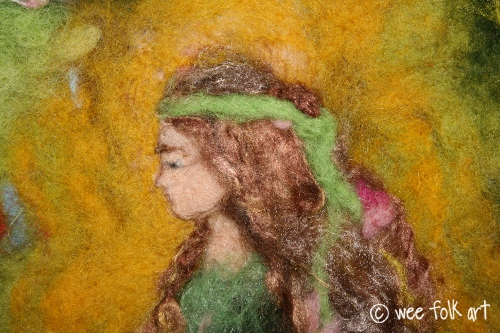
A little while ago I decided that I wanted to make a series of images to display inside the kids' play house. I think it will be nice to change these out seasonally. I didn't really have a set plan, but this seemed like a good time to try out a new medium for me... needle felting wool roving. I attempted this with a "who needs directions" attitude and just sorta winged it (of course it's not like I haven't seen the process outlined in books in the past). I learned a few things along the way and have a better idea of how I will attempt the second piece. I definitely think I have a way to go before I will feel confident in this medium... but it is fun to have a challenge like that. The kids all like it. So I guess that is a good start. Now I just need to get it a nice wood frame.

Anyone else in the middle of a "completely new to you" project?

Another Project Done!

I've learned 2 very important things in the past 24 hours. First, I'm as allergic to alpaca as I am to wool, and second, apparently my pictures turn out just as good when I'm blindly flailing the camera around as when I painstakingly try to control focus and lighting!

Yesterday, I decided to sneak in one more homemade gift. I hit my lovely local yarn store, Ewe-Nique Yarns, how cute is that, and they told me some people who are allergic to wool aren't allergic to alpaca. And this yarn felt oh so good! Debbie Bliss's Alpaca Silk. I thought, "Nothing that feels THAT good would ever hurt me!" Well, 24 hours later, I'm totally congested, my eyes itch, and any where on my body that made contact with the yarn, (and wasn't coated in Liquid Gloves), is red and itchy. Having said that, I will sing the praises of alpaca. It is such a lovely yarn to work with, and if you don't have my unreasonable constitution, lovely to wear.

And about my photography abilities...I bet you can't tell the difference between the pictures I tried to focus and those where I held the camera at arms length and Willy Nilly snapped. A rather depressing and sobering thought! Obviously, I've been going about this photography thing all wrong!

Anyway, I love how the mitts and scarf turned out. The scarf is the crocheted "One-Skein Scarf" in The Happy Hooker. I had made a couple of them last summer when I was learning to crochet. (I still consider myself a beginning student of crochet!) The mittens are from a free pattern from Kelbourne Woolens. They are so cute and nicely shaped...the shape has become my favorite mitten pattern...I will be making them again.

As far as time goes...the mitts probably took me 8 hours to knit, and the scarf 3. Hope everyone is progressing nicely on their projects! (BTW...I'm far from done...but beginning to see the light at the end of the tunnel!)

Finally Done with the Hobby Horses!

I finally finished the hobby horses. Boy, these sure have been a long undertaking. It's not that making the individual horses took that long, but when you design something instead of following a pattern, you wind up with a couple beta runs and there's usually at least some "tweakage"! The last piece was trying to decide how to best attach the heads to the dowel rods. Then, in the last moments, I decided I wanted tags, so I printed some paper and put together a label. BUT I LOVE THEM! I am very satisfied with how they turned out and I can't wait to give them to Bug (Lightning), Fairy (Daisy) and Pixie (Iris). I do plan to eventually write up instructions for the horses...obviously, at this point, it will be after Christmas. But now I can check one more project off the list. Here's some pics of the herd.


Surprise Cookies

My Bushia was a marvelous cook...of basic foods. And, hey, let's face it, we consume mostly basic foods, right? As a mother of 13 children there wasn't much time for fluff, but there was no shortage of flavor! A very Old World, traditional little lady. Now my Grandma Pearl...she was cheeky and modern. Her foods always reflected the latest trends, and she too was a marvelous cook...just different.

Today, I want to share a Christmas cookie Bushia always made. Come to think of it, it was probably the only Christmas cookie she made. The cookie was like Bushia herself...plain on the outside, but a treasure trove of richness inside! (If you'd like to hear a little more about how my heritage and grandmothers affect our holiday celebration, check out my other blog, One Generation To Another this week and read "Polish for a Day".) 

Surprise Cookies

3 1/2 cups flour
1 teaspoon soda
1/2 teaspoon salt
1/2 cup butter
1/2 cup shortening or margarine
1 cup sugar
1/2 cup brown sugar
2 eggs, unbeatened
2 tablespoons water
2 teaspoon vanilla
1 package rum, chocolate mint, or milk chocolate candy wafers
(If these are not available at your local stores, you can use chocolate chips or pieces of chocolate bars inside the cookie.)  
 
Directions
Sift together dry ingredients. Cream together butter and shortening with sugars. Add unbeaten eggs, water and vanilla to shortening mixture. Slowly add dry ingredients. Mix well. Refrigerate for at least an hour to make dough easier to handle.
 
Enclose each wafer in 1 t. of dough (might need a bit more.) Place 2 inches apart on a greased cookie sheet. Place pecan half on each cookie. Bake 10 - 12 minutes in a 375 degree oven. (Use middle shelf and watch for burning!)
 
Dust with powder sugar when done baking.

Enjoy!

Some serious issues...

Sigh... we have been trying to work with our new blog theme but are finding some inherent errors in the programing. So LOL - we will be changing things up yet again. Once we find the right fit I swear we will stop re-designing every other week (trust me - I'd rather be crafting than programming!!!). In the meantime, feel free to browse the site amongst a bit of chaos!

UPDATE - By George I think we got it! Tim spend a few minutes muddling with the coding for us and whala... he found the major glitch. We have since been busy trying to correct any formatting issues but please let us know if you find something really wonky. I know that some of the numbering is doubled in some of the directions... but as far as I can tell everything is usable and laid out so much more user friendly than a few days ago (all that crazy text wrapping).

Ding! Ding! One More Off My List

Anyone else feel like it is now a race to the finish line for Christmas gifts? This is the Airy Fairy from Knitted Toys: 25 Fresh and Fabulous Designs. Isn't she adorable? She is for my Fairy Girl... a specific request on her part. Now to finish up the Robot that Bug requested. I think these are going to be a sweet Christmas Eve gift... just before we go to church.

Collage of Projects

We thought it would be rather fun to bring together all the various projects that we shared over the past 4 months. Most of them are quick projects so if you're still in need of some Christmas ideas, most of these are very doable. Just click on the picture and it will take you to the directions. Enjoy!


Gammy's Version


Holiday Break


Like most of you, the next couple of weeks are going to be very busy! Starting, gulp, day after tomorrow, our home will be swarming with out-of-town guests, and the celebrating will begin. Although I couldn't be happier, I do feel like a deer in headlights. Rather stunned. Where did all the time go? I had months to finish every thing, now I'm down to days. Fortunately, I have all my projects done except the afghan for my son and daughter-in-law, but I'm not throwing in the towel yet!

In order to really enjoy the holidays, Michelle and I are taking the next 2 weeks off. We will check comments and emails so we can answer questions, but we will not have any new blog entries. While we are off, we hope you still make use of our site, if time permits! 

What do we have planned for the New Year? Plenty! To begin with, I've promised the pattern and directions for the Hobby Horses...that will be one of my first projects. I have been hankering to make some door stops. There are ideas for a few different kind playing gentle on my mind. You can expect to see them surfacing in January. Also, we have this lovely little button in the right column that says Crafting Glossary. Click on it and...NOTHING happens! High on my list of to-dos is to get a helpful glossary going. Because I want to work on the glossary, I decided to create some type of Glossary Project that will display all the stitches I wish to add. I haven't totally decided on the "how" or "what" yet, but it will be a great way to expand your embroidery skills.

Because many of our projects are done with felt, as will the Glossary Project, we've contacted the very sweet ladies at Prairie Point Junction. This is the shop Michelle and I use for all of our felt. They have generously agreed to offer a special discount for our Crafting Club Members. When we return in January, we will post their coupon, and give you a material list for several of our up and coming projects. This is not a money making event for Michelle and I, just an opportunity to get a discount on the materials we buy anyway! So, if you get a chance, go check out Prairie Point Junction. And, if you're like me, you'll put together a wish list!

Michelle and I want to wish everyone a happy, safe and blessed Holiday. As we are sitting around Michelle's roaring fire (pictured above) sipping our Holiday wassail, we will lift our glasses in a toast to you and offer up a prayer for you and yours!

MERRY CHRISTMAS!  

Not Really Here...


Technically, I'm not here...we're still on holiday. I told myself I wasn't going to blog for 2 weeks, so I'm not calling this a blog...let's just say I'm answering a friend's questions. She asked, "Where do you come up with your ideas and how in the world do you go about turning them into patterns?" My profound answer, "I don't know." Truth is, sometimes I'm inspired by a pic, sometimes in response to a need, and sometimes, I have a thought ping ponging around in my brain for a long time before I decide what to do with it. Case in point...doorstops. For some time I've known I wanted to make doorstops that are both functional and appealing to children but nothing was jumping out at me.

Tonight, Michelle and I managed to steal away for coffee...alone...which is unusual...and managed to have 2 1/2 glorious hours to ourselves whilst we discussed an up and coming project. When I got home, I began to doodle...always my first step in any project. Well, instead of staying on task, I started messing around with the doorstops, and before I knew it, I had the rough draft of them! There's still a lot of decisions to be made. They will have to be drawn to scale, and I'll have to decide how I want to go about making them three dimensional. I want to make them in felt and in prints, so I'll need different materials and directions for each. I'll also have to decide how to make them weighty enough to be functional. Anyway, in answer to my friend's question...it starts with an idea, it becomes a doodle, and eventually turns into a bona fide pattern! So be on the lookout for our folk art cat and dog doorstops! Now, back to vacationing!